
Overseas investors intending to convert farm land to commercial forestry need to apply under the benefit to New Zealand test. Under this pathway investments are measured against 7 benefit factors. The 7 factors are broad and are intended to enable a holistic assessment of whether the benefit to New Zealand test is met.
Applications granted under this pathway will have consent conditions applied to them that generally include using the land exclusively or nearly exclusively for forestry activities, like harvesting and replanting.
Applications from overseas investors to convert farm land to permanent forestry – for example to earn carbon credits – must meet the farm land benefit test. This is an elevated test that requires applicants to demonstrate that the benefits will be substantially higher than the current state.
Read about how the benefit test applies to farm to forestry conversion
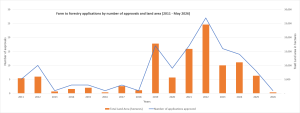
Overseas investment consents for farm to forestry conversions over time
Amendments to the Overseas Investment Act 2005 over the years have influenced the number of farm to forestry conversions consented to overseas persons. Other government policy changes may also have had an impact on conversion rates, as well as wider economic factors.
To facilitate overseas investment in forestry, in 2018 the Government changed the way overseas investments in forestry were screened under the Act, and established a streamlined consent pathway. The special forestry test was designed to facilitate more overseas investment in forestry than would be facilitated under the then-existing benefit to New Zealand test and initially farm to forestry conversions could use this pathway.
In 2022, the rules for overseas investments in forestry changed to make it harder for overseas investors to purchase New Zealand farm land for conversion to production forestry, by requiring they meet the stricter benefit to New Zealand test. This test measures an investment against factors such as how it benefits the economy and the natural environment. The test also gives decision-makers discretion to consider factors including the land’s environmental features and how productive it is.
The special forestry test allows a trusted investor that meets our criteria to obtain a ‘standing consent’. This allows the investor to make investments under the umbrella of a consent that is already in place, and to notify LINZ of each transaction.
There were 6 standing consents granted between 2019 and 2021 that allowed investors to acquire farm land to use for forestry purposes under the special forestry test, the last of which expired in 2024. 24 transactions occurred under a standing consent for these purposes.
All current and future standing consent holders are limited to purchasing existing forestry land only and may not use the standing consent to buy farm land.
Read about standing consents at
Investing in forestry and forestry rights
| Year | Approved applications (Benefit to New Zealand pathway) | Approved applications (Special forestry test pathway) | Total number of approved applications | Number of Transactions under a Standing Consent |
|---|---|---|---|---|
| 2011 | 5 | - | 5 | |
| 2012 | 10 | - | 10 | |
| 2013 | 1 | - | 1 | |
| 2014 | 3 | - | 3 | |
| 2015 | 3 | - | 3 | |
| 2016 | 1 | - | 1 | |
| 2017 | 3 | - | 3 | |
| 2018 | 1 | - | 1 | |
| 2019 | 2 | 15 | 17 | |
| 2020 | - | 9 | 9 | |
| 2021 | - | 17 | 19 | 2 |
| 2022 | - | 27 | 35 | 8 |
| 2023 | 4 | 12 | 28 | 12 |
| 2024 | 14 | - | 16 | 2 |
| 2025 | 6 | - | 6 | |
| 2026 | 1 | - | 1 | |
| Totals | 53 | 80 | 157 | 24 |
| Year | Benefit to New Zealand pathway | Special forestry test pathway | Transactions under a Standing Consent | Total area (hectares)* |
|---|---|---|---|---|
| 2011 | 5,406 | - | 5,406 | |
| 2012 | 5,973 | - | 5,973 | |
| 2013 | 696 | - | 696 | |
| 2014 | 1,585 | - | 1,585 | |
| 2015 | 2,032 | - | 2,032 | |
| 2016 | 381 | - | 381 | |
| 2017 | 2,576 | - | 2,576 | |
| 2018 | 1,147 | - | 1,147 | |
| 2019 | 1,967 | 15,818 | 17,785 | |
| 2020 | - | 5,073 | 5,073 | |
| 2021 | - | 15,924 | 895 | 16,819 |
| 2022 | - | 24,633 | 3,144 | 27,777 |
| 2023 | 2,739 | 7,294 | 4,153 | 14,202 |
| 2024 | 11,075 | - | 714 | 11,789 |
| 2025 | 4,892 | - | - | 4,892 |
| 2026 | 360 | - | - | 360 |
| Totals | 40,469 | 68,742 | 8,906 | 118,133* |
* This is the total of land area acquired and does not indicate the amount of new forestry.
Land Use Capability (LUC)
The Government has announced changes to balance and recognise the value of both forestry and farming, while providing certainty for food producers. One proposed change is a national limit of 15,000 hectares per year for exotic forest land registered in the Emissions Trading Scheme if planted on Land Use Capability (LUC) 6 farmland, and further rules for LUC 1 to 5 land.
In 2024 approximately 71% of the farm land acquired for forestry conversions under the Overseas Investment Act was classed as LUC 6 land.
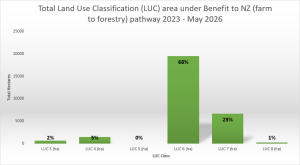
View data as a table
| Year | LUC 3 (ha) | LUC 4 (ha) | LUC 5 (ha) | LUC 6 (ha) | LUC 7 (ha) | LUC 8 (ha) |
|---|---|---|---|---|---|---|
| Percentage | 2% | 5% | 0% | 68% | 23% | 1% |
The new regulations are expected to come into effect in October 2025, and are likely to have an impact on farm to forestry conversions.