
The text was originally published in the New Zealand Alpine Journal, 2014; v.66:p.134-139.
David John Albert (Bert) Lyttle
Bert Lyttle was a mountaineer and First World War Serviceperson. He served in the Otago Infantry Battalion. Lyttle did not return from the fighting.

Portrait, Auckland Weekly News 1915 Accessed from - http://api.digitalnz.org/records/43217173/source
David John Albert (Bert) Lyttle [Service No.8/1107] was a member of the group led by mountaineer Bill Grave in his Fiordland explorations over the summers 1908-1911. In three major expeditions with Grave and Arthur Talbot, Lyttle helped discover the Grave-Talbot Route from the Hollyford River / Whakatipu Kā Tuka to Milford Sound / Piopiotahi. Twice they started from Lake Wakatipu, examining Moraine Creek, Lake Marian, Homer Saddle and Gertrude Saddle, looking for an alternative to the Milford Track. On the second expedition Lyttle was unwell so he could not join the others when they managed to cross to the Esperance River and Milford Sound / Piopiotahi. The next season he played a fuller role, making a double crossing from Milford Sound to the Hollyford River / Whakatipu Kā Tuka and back with Grave and Talbot, but the route remained one for mountaineers rather than walkers.
Born at Waikaia on 28 January 1888, Lyttle had a considerable history of military activity, as a school cadet 1901-1903, and then in various volunteer units for the next nine years in Gore. He became 2nd Lieutenant in the 14th (South Otago) Regiment of Territorials based in Kaitangata (South Otago) from 22 December 1913.
Of solid build, Lyttle was a teacher in Kaitangata in September 1914 when he enlisted to serve in the First World War in the Otago Infantry Battalion, just a month after the beginning of the war. He left with the first contingent of the New Zealand Expeditionary Force in mid-October. After time in Egypt, Lyttle was in one of the early landings at Gallipoli, and soon killed. Initially he was recorded as ‘Wounded’ and then as ‘Wounded & Missing’, before a verdict of 'Killed in Action’ was brought in on 23 May 1915. Two formal enquiries into his death occurred in 1915. The inquiry in June concluded he died on 2 May 1915 and the one in December that he died on 3 May 1915. In the shambles of warfare on the cliffs of Gallipoli, good record-keeping was not always possible.
Places
Lyttles Farm - NZGB Gazetteer | linz.govt.nz
Lyttle Falls - NZGB Gazetteer | linz.govt.nz
Mount Lyttle - NZGB Gazetteer | linz.govt.nz
Further reading
- David John Albert (Bert) Lyttle - Auckland Museum Cenotaph Record
- Auckland Weekly News, 24 June 1915, p. 21
- Anita Crozier, Beyond the Southern Lakes: the explorations of W.G. Grave, Reed, Auckland, 1950
Bernard Head
Bernard Head was a mountaineer and First World War Serviceperson. Head did not return from the fighting.
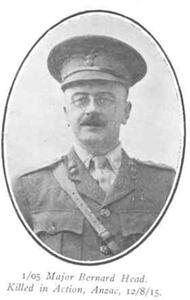
Stephen John Smith, The Samoa (N.Z.) Expeditionary Force 1914-1915: an account based on official records of the seizure and occupation by New Zealand of the German Islands of Western Samoa, Wellington, 1924, p 180
Major Bernard Head [Service No.1/05; British forces B.R.37/1261] was an enthusiastic English climber. He was an active mountaineer 1909-1914 and liked exploratory mountaineering. He was among the first to climb Mount Aspiring / Tititea, with guides Jack Clarke and Alex Graham, on 23 November 1909; the first over Bernard Col into Landsborough River (at the head of Mueller Glacier); and the first ascent of Mount Edward during exploration of the head of Dart River / Te Awa Whakatipu. He also strongly advocated for New Zealanders to explore the potential of skiing and other winter sports.
Born about 1876, Head really wanted a military career, but his poor eyesight, which necessitated guides when climbing, meant a permanent commission in the British Army was not possible. He served with distinction as a volunteer officer in the South African War and was involved in various volunteer and Territorial units, including the 5th (Flintshire) Battalion of the Royal Welsh Fusiliers.
Head was in New Zealand for mountaineering when war broke out in early August 1914. He was quick to offer his services to the New Zealand Armed Forces. He was given a King’s Commission without attestation or medical examination, and within 10 days of the declaration of war he left New Zealand on the Monowai for Samoa as a Major, second-in-command of the New Zealand force. He left Samoa on 4 January 1915, probably seeking a more active role in the war. He sailed for England in February 1915 and rejoined the 5th (Flintshire) Battalion of the Royal Welsh Fusiliers. He reached Gallipoli as a Major in August 1915 and was killed by sniper fire on 12 August 1915, aged 39.
Places
Bernard Col - NZGB Gazetteer | linz.govt.nz
Mount Head - NZGB Gazetteer | linz.govt.nz
Further reading
- Bernard Head - Auckland Museum Cenotaph Record
- Bernard Head, ‘Account of expeditions up the Matukituki River, 1909 and 1911’, in Laurence Fearnley and Paul Hersey (eds), To the mountains: a collection of New Zealand alpine writing, Otago University Press, Dunedin, 2018
- Stephen John Smith, The Samoa (N.Z.) Expeditionary Force 1914-1915 : an account based on official records of the seizure and occupation by New Zealand of the German Islands of Western Samoa, Wellington, 1924
James (Jim) Dennistoun
Jim Dennistoun was a mountaineer and First World War Serviceperson. Dennistoun did not return from the fighting.

James (Jim) Dennistoun [British forces; Base records query B.R.37/17] was an adventurer, climber and explorer who revelled in transalpine exploration which revealed 'new' peaks or the secrets of unsurveyed topography. While he climbed high in the Aoraki / Mount Cook region 1910-1911, notably with his sister Barbara, friend Ada Julius and guide Jack Clarke, his greatest enjoyment came from exploration of Rangitata and Whataroa Rivers from 1908 to 1910, and a transalpine trip from Rangitata River to the Hermitage Hotel in January 1914. He is recorded as the first to climb Mitre Peak at Milford Sound / Piopiotahi, on 13 March 1911.
Dennistoun’s exploits also encompassed a voyage to Antarctica on the Terra Nova from November 1911 to April 1912, as support to Robert Scott’s South Pole expedition. They returned not knowing that Scott and his companions were already dead.
Dennistoun was born at Peel Forest, South Canterbury, on 7 March 1883, and educated in New Zealand and England. He learned to run a sheep station by helping his father and briefly owned several other sheep stations himself before the war. Just before war broke out, he bought a property at Mangamahu near Taihape with his cousin Guy Russell (later Sir Andrew Russell, commander of the New Zealand Division). Russell’s military commitments meant responsibility for the station rested with Dennistoun.
Ever restless, once he had a manager settled on the property, Dennistoun worked his passage to England in April 1915 and joined the North Irish Horse as a 2nd Lieutenant. He went to the Western Front in November 1915 where he acted for a time as an intelligence officer. Always looking for a new challenge, he was then attached to the Royal Flying Corps.
On 26 June 1916 Dennistoun was returning from a bombing expedition to Biache (France) when the biplane he was an observer in was attacked. Both he and the pilot (his first cousin Herbert Russell) were severely wounded, Dennistoun in the stomach. Though Dennistoun was able to keep firing at their attackers, Russell blacked out for a time, the engine caught fire, and they were compelled to crash land in German second line trenches east of Arras. After two major operations Dennistoun seemed on the road to recovery, writing to his parents and sister who were in England, but then his condition deteriorated. After a third operation in a German hospital at Ohrdruf he died on 9 August 1916.
Places
Dennistoun - Glacier NZGB Gazetteer | linz.govt.nz
Dennistoun Pass - NZGB Gazetteer | linz.govt.nz
Dennistoun Peak - NZGB Gazetteer | linz.govt.nz
Further reading
- James Robert Dennistoun, Auckland Museum Cenotaph Record
- James Robert Dennistoun, The Peaks and Passes of J.R.D., Geraldine, 1999
- James Robert Dennistoun, ‘First to the summit : Mitre Peak, Milford Sound’ in Laurence Fearnley and Paul Hersey (eds), To the mountains: a collection of New Zealand alpine writing, Otago University Press, Dunedin, 2018
- North Irish Horse Regiment website
Arthur Talbot
Arthur Talbot was an accomplished mountaineer and First World War Serviceperson. Before the war, he explored Fiordland National Park extensively with his friend William (Bill) Grave. He did not return from the fighting.

From left, William (Bill) Grave and Arthur Talbot during a tramping or mountaineering trip around 1899.
W G Grave and Arthur Talbot. Ref: 1/2-051222-F. Alexander Turnbull Library, Wellington, New Zealand. W G Grave and Arthur Talbot | Items | National Library of New Zealand | National Library of New Zealand
Arthur Talbot [Service No.14037] was the most consistent companion of mountaineer William (Bill) Grave. They climbed and explored in Fiordland on seven expeditions from January 1903, when Talbot was a fellow newcomer with Bernard Tennent on a rainless trip, to December 1913 when they made a first ascent of Mount Pembroke.
Travel in Fiordland was far from easy, but Talbot stuck at it almost as long as Grave. Their first trip together, with Thomas Hunter and Tennent, was fortunate to have fine weather for their explorations up Worsley Stream from Lake Te Anau and over to Hāwea / Bligh Sound, and back. The next year they also started from Worsley Stream but headed further north and over to Te Hāpua / Sutherland Sound. In January 1906, Talbot and Grave explored from the north branch of Clinton River to Lake Iceberg, over Marshall Pass into the head of Joes River, including Talbot River. The pair climbed a peak north of Mount Kepka before dropping down to the Milford Track, reached with difficulty, and crossing back over Omanui / Mackinnon Pass.
Talbot was instrumental in the discovery of the Grave-Talbot Route from Hollyford River to Milford Sound / Piopiotahi 1908-1911, first from Milford Sound / Piopiotahi in the south, and then from Hollyford River / Whakatipu Kā Tuka in the north. He and Grave climbed Mount McPherson in January 1910 and managed to scramble down into Esperance River. The following year they made a double crossing of the route and a first recorded ascent of Mount Balloon from the Milford Track. In December 1913 Talbot, Grave, Duncan Macpherson and guide Jack Lippe made a first recorded ascent of Mount Pembroke at Milford Sound / Piopiotahi, but weather foiled an attempt at Mitre Peak.
A fine climber, Talbot also explored up Waimakariri River in 1913 when he lived in Greymouth. Climbs included a second recorded ascent and first recorded traverse of Mount Davie, a first recorded ascent of Mount Murchison, and a possible first recorded ascent of Mount Harper / Mahaanui – nomenclature and location of peaks was uncertain in this unsurveyed area. Tall and dark, he showed great courage and never let his companions down.
Born in 1877 in Temuka, the second of eight boys, Talbot became a teacher. He had his military service medical on 14 August 1915, but did not officially join the Canterbury Infantry Regiment until 12 January 1916. He began as a corporal but was soon made a second lieutenant.
In July 1916, while in training, he married in Wellington. After arrival in England on 29 January 1917 and the usual instruction at Sling Camp, he was on the Western Front by mid-April. A daughter was born in June, but Talbot never saw her. Though initially reported wounded, he was actually killed at Passchendaele on 12 October 1917, one of hundreds of New Zealanders to die that day.
Places
Mount Talbot - NZGB Gazetteer | linz.govt.nz
Talbot’s Ladder - NZGB Gazetteer | linz.govt.nz
Talbot River - NZGB Gazetteer | linz.govt.nz
Grave-Talbot Pass - NZGB Gazetteer | linz.govt.nz
Further reading
- Arthur Talbot, Auckland Museum Cenotaph Museum
- Anita Crozier, Beyond the Southern Lakes: the explorations of W.G. Grave, Reed, Auckland, 1950
Bernard Tennent
Bernard Tennent was a sometimes mountaineer and First World War Serviceperson. He did not return from the fighting.

From left, William (Bill) Grave, Bernard (Bernie) Tennent and Arthur Talbot at the mouth of Worsley River, January 1903. Accessed from - Grave, Tennent and Talbot. Campsite at the Worsley mouth - Culture Waitaki
Bernard Tennent [British forces; Service records D.2/2035 & B.R. 37/1383] took part in one major Fiordland expedition with William (Bill) Grave, Arthur Talbot and Thomas Hunter in January 1903. Of the group’s various trips into Fiordland National Park, this was the only one with fine weather. From Lake Te Anau they went up Worsley River to Lookout Peak, over Worsley Pass, down Wild Natives River to Hāwea / Bligh Sound, coming across Lake Bernard on the way. They returned by the same route.
Born in Australia on 28 November 1882, Tennent came to New Zealand as a boy with his family. He was educated in Dunedin and then worked in Timaru before training as a doctor at Edinburgh University. When war broke out he became a captain in the No.7 Field Ambulance of the Royal Army Medical Corps. By early 1915 he was at the Western Front in charge of five motor ambulances, used to help convey the wounded from the front lines back to base hospitals. He worked as a medic in this way throughout the war, often exposing himself to danger. The citation for the Military Cross he was awarded on 22 August 1917 reads:
For conspicuous gallantry and devotion to duty in continuously exposing himself with the utmost fearlessness under heavy shell-fire, in order to visit his posts in the front trenches. He dressed many men in the open, regardless of personal danger, and when his bearers became casualties he took their places and assisted to carry the wounded himself.
He continued to rescue the wounded from the front lines and eventually he suffered for his bravery, dying on 23 August 1918 of wounds he had received.
Place
Lake Bernard - NZGB Gazetteer | linz.govt.nz
Bernard Burn - NZGB Gazetteer | linz.govt.nz
Further reading
- Bernard Charles Tennent - Auckland Museum Cenotaph Record
- Anita Crozier, Beyond the Southern Lakes: the explorations of W.G. Grave, Reed, Auckland, 1950
John (Jack) Robert Murrell
Jack Murrell was a mountaineering guide at the Hermitage Hotel before enlisting during the First World War. He did not return from the fighting.

Source: Auckland Cenotaph
John (Jack) Robert Murrell [Service No.59216] was both a guide and an independent climber. He guided on the Milford Track, and his first real climb was the second recorded ascent of Mount Aspiring / Tititea by the northwest ridge on 10 March 1913. Murrell climbed in Milford Sound / Piopiotahi area with Edgar Williams, ascending Mount Balloon, Mount Wilmur (named for the first parts of their surnames) and Mount Hart in February 1914, and Mount Elliot in January 1917. The pair also made the second recorded ascent of Mitre Peak. Murrell was employed at the Hermitage Hotel for the 1915-1916 season, when guides were in short supply, climbing Mount Sealy and Mount Montgomerie, and Aoraki / Mount Cook by Linda Glacier.
Born in Lumsden on 14 September 1886, Murrell’s main employment was as a shepherd for his father, based at Manapouri. Of solid build, he enlisted on 17 March 1917, but did not join up formally until June. After training he left for overseas on 13 October 1917. Like many New Zealand soldiers going into a British winter after a long sea voyage, Murrell was quite unwell on arrival in England. He spent three months either in hospital or convalescing, recovering from bronchitis. He finally reached the Western Front on 19 May 1918, joining the 2nd Battalion of the 3rd New Zealand Rifle Brigade. He was killed in action on 8 September 1918 near Gouzeaucourt Wood, north of the Somme, aged 31, just two months before the end of the war.
Place
Mount Wilmur - NZGB Gazetteer | linz.govt.nz